 PlantProblem
Fiddle Leaf Fig Brown Spots: Edge vs. Middle vs. Whole Leaf
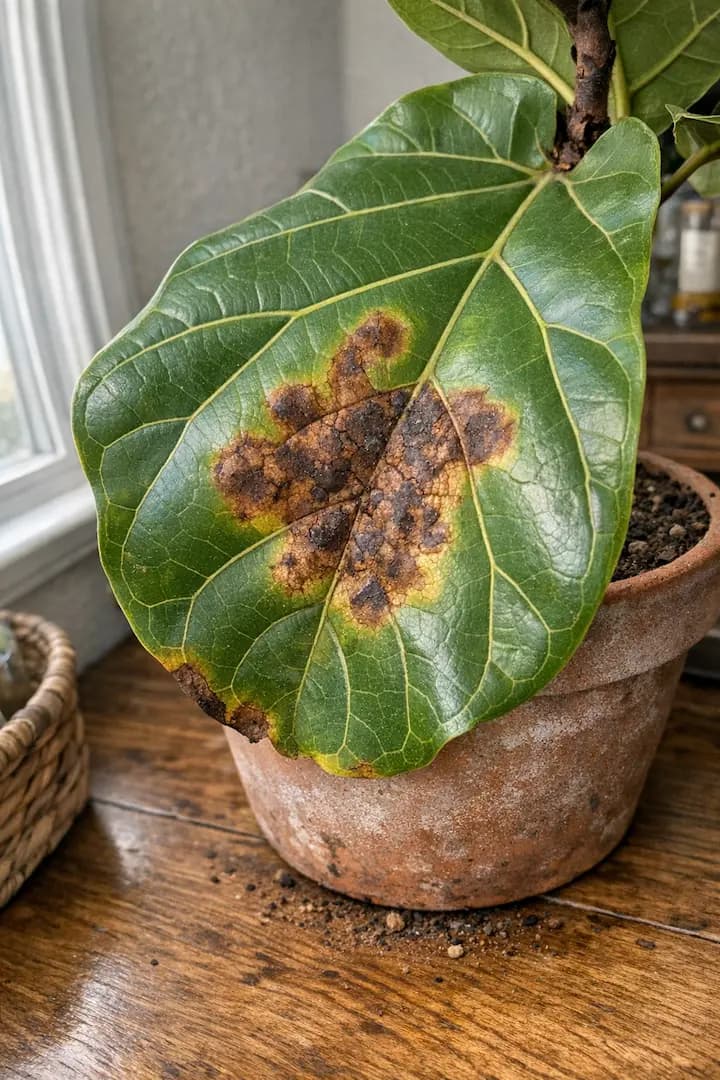
Fiddle leaf figs are not complicated. They just punish guessing.
Brown spots look the same from a distance. Up close, where they appear on the leaf tells you everything. A spot at the edge means something different from a spot in the middle. A spot on the lower leaves means something different from one at the top. Get the location right and the cause becomes obvious.
| Where the brown spot appears | Most likely reason |
|---|---|
| Edges and tips, lower leaves first | Underwatering or low humidity |
| Center of the leaf, irregular shape | Root rot from overwatering |
| Brown spots with yellow halo around them | Bacterial infection |
| Small, uniform spots across many leaves | Sunburn or dry air |
| New leaves at the top browning first | Cold draft or temperature stress |
| Brown spreading from the midrib outward | Severe root damage |
Brown at the Edges
Edge browning on fiddle leaf figs starts at the tips and works inward. The affected area is dry and crispy, not soft.
Two causes produce this pattern: inconsistent watering and low humidity. Both stress the leaf at its outermost point first. In winter, when heating systems drop indoor humidity below 30%, edge browning accelerates even with perfect watering.
Check watering first. The top two to three centimeters of soil should dry out between waterings, but not more than that. Fiddle leaf figs don't like drought. If the soil is consistently dry for days before you water, that's enough to cause edge damage.
A humidifier placed within two meters of the plant handles the humidity side. Grouping it with other plants helps slightly but not enough on its own in a heated room in winter.
Brown in the Center of the Leaf
A brown spot that appears in the middle of the leaf, not at the edge, is almost always a root problem.
When roots sit in waterlogged soil, they lose the ability to transport water and nutrients efficiently. The plant shows this first in the oldest leaves at the bottom, and the spots appear irregularly shaped, often with a slightly darker border. The leaf around the spot may look fine initially, then yellow over the following weeks.
Pull the plant out of its pot. If the roots are brown and mushy rather than white and firm, root rot is the cause. Trim the damaged roots, let them air dry for an hour, and repot in fresh well-draining soil in a pot with drainage. A moisture meter used before every watering prevents this from recurring.
Brown Spots with a Yellow Halo
This pattern is bacterial infection. It looks distinct once you know what you're looking for.
The spot itself is brown and irregularly shaped. The leaf tissue around it turns yellow in a ring. It spreads to other leaves if left alone, usually moving upward through the plant. Overwatering creates the conditions for bacterial infections to take hold, so the two problems often appear together.
Remove every affected leaf immediately with clean scissors. Disinfect the scissors between cuts. Improve airflow around the plant and reduce watering. There is no spray that eliminates the bacteria reliably once it's established inside the tissue. Removal and prevention are the only tools that work.
Sunburn
Fiddle leaf figs like bright indirect light. Direct sun through a window burns them.
Sunburn shows as small, dry, bleached-looking spots scattered across the surface of the leaf rather than concentrated at the edges or center. The spots appear on whichever side faces the light source. They don't spread and they don't indicate anything wrong with the roots.
Move the plant back from the window until it receives bright light without direct rays hitting the leaves. A sheer curtain between the plant and a south or west-facing window is usually enough. The burned spots don't recover but new leaves come in undamaged.
Cold Drafts
Fiddle leaf figs are sensitive to temperature drops and air movement in a way that most houseplants are not.
A plant sitting near an air conditioning unit, a frequently opened door, or a drafty window will develop brown spots on the newest growth first. The top leaves are the most actively growing and the most vulnerable to stress. If the browning is concentrated at the top of the plant and the lower leaves look fine, temperature or airflow is the likely cause.
Check what's within one meter of the plant. Move it away from any direct airflow source and keep it away from windows left open in cold weather. Fiddle leaf figs do best when temperature stays consistently between 16°C and 27°C with no sudden drops.
What To Do Right Now
- Look at where the brown is before doing anything else. Edge browning and center browning have opposite fixes and treating one as the other makes things worse
- Check the roots if the spots are in the center of the leaf or spreading from the midrib. Mushy brown roots need to be removed today, not next weekend
- Remove any leaf with a yellow halo around the brown spot immediately and keep removing them as they appear
- Move the plant away from any direct sun, vents, or drafty windows before considering any other fix
- Let the soil dry to three centimeters deep before the next watering and don't water on a fixed schedule
Keep reading
// Newsletter
New plant problem? We'll email you the fix.
No spam. One email when we publish something useful.
No spam. Unsubscribe any time.