 PlantProblem
Why Is My Pothos Not Growing? 6 Things You're Probably Doing Wrong
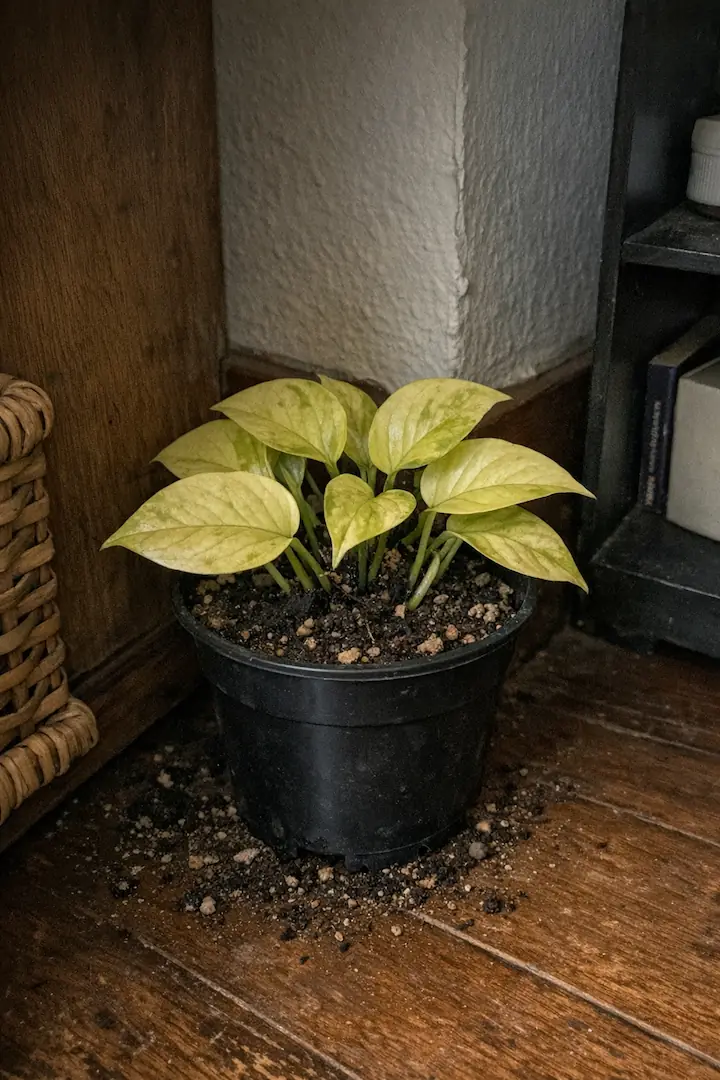
A pothos that isn't growing isn't dying. It's waiting. The difference between a plant that puts out a new leaf every two weeks and one that sits completely still for months comes down to six things. Almost always, just one of them is the actual problem.
| What you're seeing | Most likely reason |
|---|---|
| No new leaves for weeks, stems look leggy | Not enough light |
| Stopped growing in October–February | Normal winter dormancy |
| Roots coming out the drainage holes | Needs a bigger pot |
| No growth despite good light and watering | No nutrients in the soil |
| Soil stays wet for more than a week | Overwatering slowing root function |
| Growth stopped after moving to a new spot | Temperature or draft stress |
Not Enough Light
This is the reason in the majority of cases.
Pothos tolerates low light. It does not grow in it. Growth requires energy, and energy comes from photosynthesis. Below a certain light threshold, the plant produces just enough to survive. Nothing more.
The sign: the plant looks healthy, leaves are green, but nothing new appears for weeks. Sometimes the new leaves that do appear are noticeably smaller than the old ones.
Move it to within two meters of a window. Not behind furniture, not in a hallway. It needs to be within actual reach of natural light. North-facing rooms with no direct sun are usually not enough. If your space genuinely doesn't have adequate light, a grow light running 12 hours a day solves this completely.
Winter Dormancy
Pothos slows down significantly between October and February.
Shorter days mean less light. Less light means less energy for new growth. This is not a problem — it's biology. If your plant stopped growing in fall and you've changed nothing, wait. Growth resumes on its own when days get longer in late February or March.
Trying to force growth in winter by fertilizing more or watering more usually causes more harm than good.
Root Bound
A plant whose roots have filled the entire pot has no room to expand.
Growth above ground mirrors growth below ground. If the roots are stuck, the leaves stop too. Check by pulling the plant gently out of its pot. If you see a dense mass of roots with almost no visible soil, it needs more space.
Go up one pot size. Two to three inches wider in diameter is enough. Too much extra space causes waterlogging, which creates a different problem entirely.
No Nutrients in the Soil
Potting mix starts with a fixed amount of nutrients. After six months of regular watering, most of those nutrients have been flushed out.
Nitrogen is the nutrient most directly tied to leaf production. Without it, the plant maintains what it has but produces nothing new. A balanced liquid fertilizer with an NPK of 20-20-20 applied once a month from spring through summer is enough. Nothing specialized needed.
Stop fertilizing in fall and winter. Feeding a dormant plant pushes salts into the soil without the plant being able to use them.
Overwatering
Roots sitting in wet soil can't function properly.
They need both water and oxygen. Soggy soil cuts off the oxygen side of that equation. A plant with stressed roots can't sustain active growth even if everything else is right.
This is different from root rot. The roots don't need to be rotting to slow the plant down. Consistently damp soil is enough. Let the top two inches dry out completely before watering again. In a home with moderate humidity, that usually means every 10 to 14 days in summer, less in winter.
Temperature and Drafts
Pothos grows actively between 18°C and 30°C. Below 15°C, growth slows. Below 10°C, it stops.
The less obvious version: a plant near an air conditioning unit or a drafty window in winter may be in a room that feels warm but is receiving cold air directly on its leaves. Move it away from any direct airflow and check if new growth appears within three to four weeks.
What To Do Right Now
- Count the hours of natural light your pothos actually receives. Less than two hours of indirect light is not enough for active growth
- Check the calendar. Between October and February, reduced growth is expected and normal
- Pull the plant out of its pot and look at the roots. A solid mass with no visible soil means repotting is overdue
- Check when you last fertilized. If it's been more than six months without feeding, that's likely the missing piece
Keep reading
// Newsletter
New plant problem? We'll email you the fix.
No spam. One email when we publish something useful.
No spam. Unsubscribe any time.