 PlantProblem
Snake Plant Dying? Here's Exactly What's Wrong
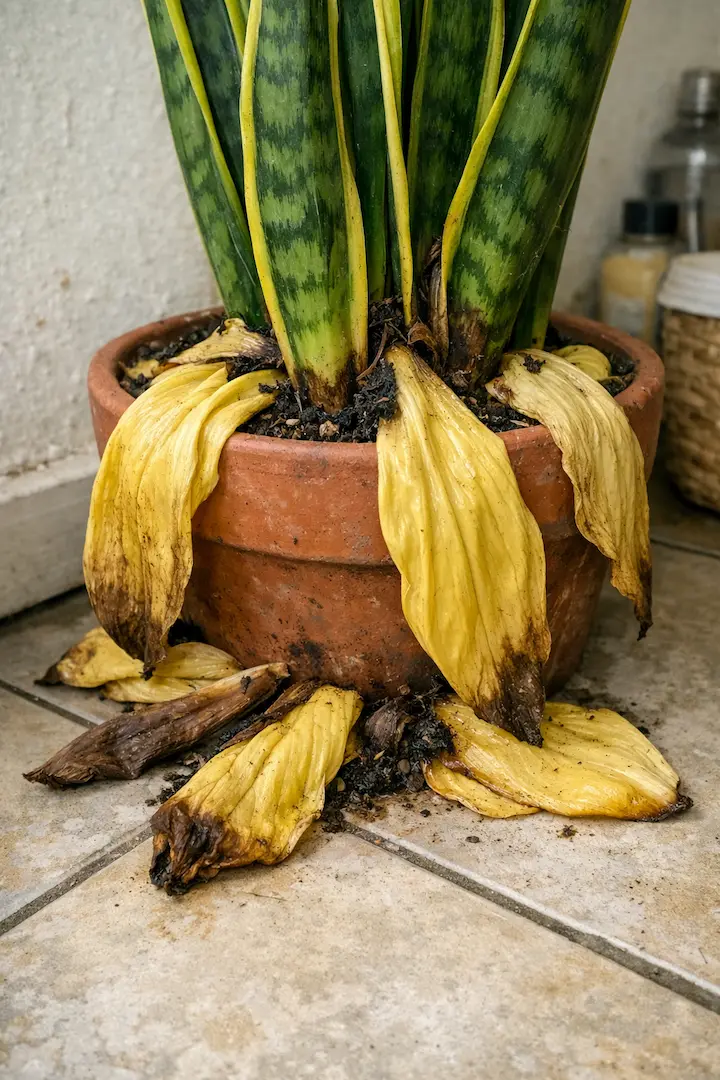
Snake plants survive in offices with no windows, in corners nobody looks at, in soil that hasn't been changed in four years. They are not delicate.
If yours is dying, something specific is wrong. The plant is telling you exactly what it is. You just need to know how to read it.
| What you're seeing | Most likely cause |
|---|---|
| Yellow leaves, soft base, wet soil | Overwatering. Check roots immediately. |
| Brown mushy leaves at soil level | Root rot. Already advanced. |
| Wrinkled or curling leaves, dry soil | Underwatering. Rare but possible. |
| Brown crispy leaf tips | Low humidity or fluoride in tap water. |
| Leaves falling over sideways | Overwatering or root rot weakening the base. |
| No new growth for months | Too dark or wrong season. Normal in winter. |
| White crusty residue on soil | Mineral buildup from tap water. Not dangerous. |
Overwatering Is the Cause Most of the Time
Snake plants store water in their leaves. They do not need frequent watering.
A snake plant watered every week in a pot without drainage will develop root rot within two months. The leaves go yellow, then soft, then collapse. By the time the damage is visible above soil, the roots are already gone.
The fix before rot sets in: stop watering completely and let the soil dry out over two to three weeks. If the leaves are still firm, the plant recovers on its own. If the base is soft when you squeeze it, the rot has reached the stem and you need to act faster.
What Root Rot Looks Like in a Snake Plant
Pull the plant out and look at the base where the leaves meet the soil.
Healthy tissue is firm and cream colored. Rotted tissue is brown, soft, and comes apart when you press it. A sour smell from the roots confirms it.
Cut every rotted section off with clean scissors. Cut into healthy tissue, one centimeter above where the damage ends. Treat the cuts with a fungicide, let the plant air dry for an hour, then repot in fresh dry soil. Do not water for ten days.
If the rot has reached the base of every leaf, propagate what you can. Cut healthy leaf sections into twenty centimeter pieces and place them in dry soil. Snake plants propagate easily even from damaged plants.
Brown Tips Are a Separate Problem
Crispy brown tips are almost never a watering problem. They are a water quality problem.
Tap water contains fluoride and chlorine. Snake plants are sensitive to both. Over time the minerals accumulate in the leaves and burn the tips. The damage is permanent on affected leaves but stops spreading once you switch to filtered or rainwater.
Low humidity does the same thing. A snake plant next to a heating vent in winter will develop crispy tips regardless of watering. Moving it one meter away from the heat source solves it.
No Growth Is Usually Fine
Snake plants go dormant in winter. No new leaves from November through February is completely normal and not a sign of a problem.
If there is no growth in spring or summer, the plant is almost certainly in too little light. Snake plants tolerate low light but grow only in bright indirect light. Move it within one and a half meters of a window and new growth appears within four to six weeks.
What To Do Right Now
- Squeeze the base of each leaf where it meets the soil. Softness there means rot and the plant needs to come out of the pot today
- If the soil is wet and has been wet for more than two weeks, stop watering regardless of what the leaves look like
- Brown crispy tips with otherwise healthy leaves mean water quality or heat exposure, not a watering problem
- No growth in spring or summer means move it closer to a window before changing anything else
Keep reading
// Newsletter
New plant problem? We'll email you the fix.
No spam. One email when we publish something useful.
No spam. Unsubscribe any time.