 PlantProblem
Root Rot: The Complete Guide (Every Plant, Every Stage)
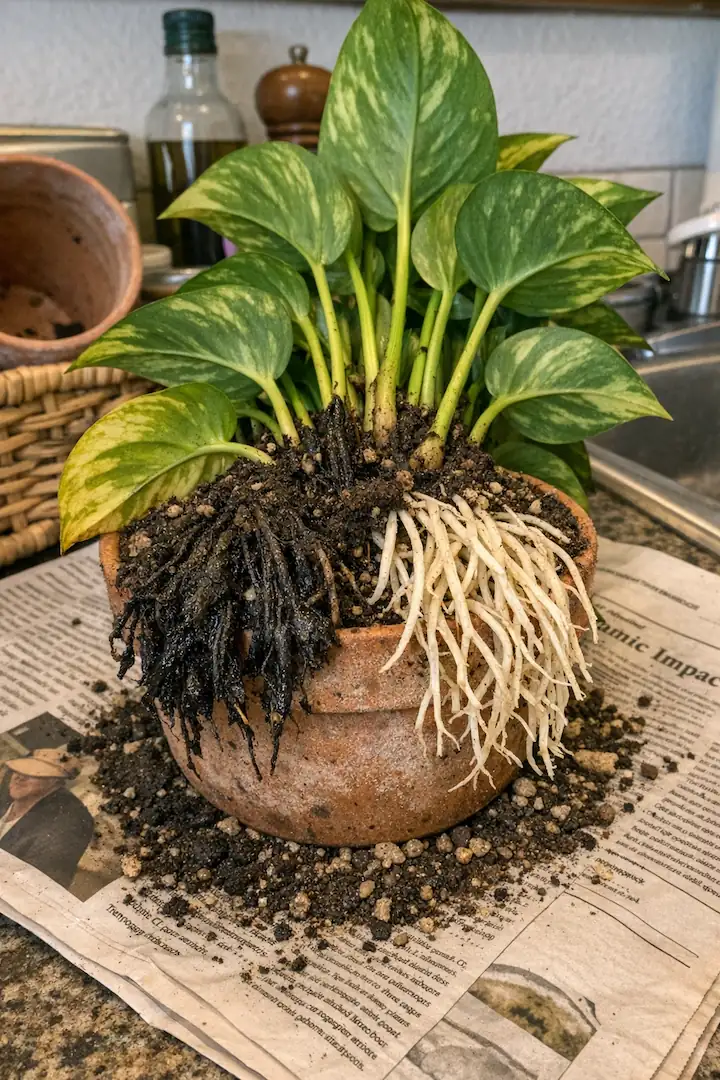
Root rot kills more houseplants than anything else. Not pests. Not underwatering. Not low light.
The reason it's so effective is that it happens underground and out of sight, and by the time the leaves show symptoms the roots have often been compromised for weeks. The plant looks fine until it doesn't, and then it declines fast.
The good news is that root rot is almost entirely preventable and frequently survivable if you catch it before more than half the root system is gone.
| What you're seeing | What it means |
|---|---|
| Yellowing lower leaves, soil still wet | Early warning, check roots now |
| Wilting despite wet soil | Roots can't deliver water, advanced stage |
| Brown mushy stems at the base | Severe rot, act today |
| Soil smelling like decay | Active rot, unpot immediately |
| Roots brown and soft when you check | Confirmed root rot |
| Plant collapsing despite regular care | Root system likely gone, salvage what remains |
What Root Rot Actually Is
Root rot is not a single disease. It's a condition caused by several different fungal and bacterial pathogens, most commonly Phytophthora, Pythium, and Rhizoctonia, that thrive in waterlogged, oxygen-depleted soil.
Healthy roots need both water and oxygen. When soil stays saturated for extended periods, the air pockets between soil particles fill with water and oxygen disappears. The roots begin to suffocate. Suffocating roots are vulnerable to the pathogens that cause rot. The rot spreads from the root tips inward toward the crown and up into the stems.
This is why root rot can develop even in plants that are watered correctly but sitting in pots without drainage, or in pots too large for the root ball, or in soil that compacts and holds moisture long after it should have dried.
How to Diagnose It
Pull the plant out of its pot. This is the only way to know for certain.
Healthy roots are white, cream, or light tan. They are firm when you press them and don't come apart when handled. They may have fine root hairs visible along the length.
Rotting roots are brown, dark gray, or black. They are soft and mushy when pressed. They may pull apart or disintegrate when handled. In advanced cases they smell like decay. The outer layer of the root may slide off when you run your fingers along it, leaving a thin wire-like core behind.
Roots that are tan or light brown and still firm are likely just stained from soil or tannins and are probably healthy. Color alone without softness is not confirmation of rot.
Treatment — Early Stage
Early stage means less than a third of the root system is affected and the stems are still firm.
Remove the plant from its pot and shake off all the old soil. Rinse the roots under lukewarm water to get a clear view of what you're working with. Use clean scissors or pruning shears wiped with rubbing alcohol and cut away every root that is soft, dark, or mushy. Cut back to firm white tissue even if that means removing significant portions of the root system.
Dust the cut surfaces with powdered cinnamon or a copper-based fungicide. Both have antifungal properties that reduce the chance of the rot continuing in the healthy tissue.
Let the roots air dry for one to two hours before repotting.
Repot in fresh, dry, well-draining soil. Do not reuse the old soil — it contains the pathogens that caused the rot. Choose a pot only slightly larger than the remaining root ball with drainage holes. Water lightly once after repotting and then wait ten days before watering again.
Treatment — Advanced Stage
Advanced stage means more than half the roots are affected, the stems may be soft near the base, or the plant is wilting despite wet soil.
The process is the same as early stage but more aggressive. Remove all damaged roots without hesitation. If removing the rot means you're left with only a few healthy roots, that is still worth attempting. Plants can regrow significant root systems from a small healthy base if given the right conditions.
After repotting, remove one third of the foliage by cutting back stems or individual leaves. A plant with a severely reduced root system cannot support its full leaf load. Reducing the above-ground mass gives the remaining roots a chance to recover without being overwhelmed by demand.
Place the plant in bright indirect light rather than its usual spot and keep it out of direct sun while it recovers. Do not fertilize for at least two months. A stressed root system cannot process nutrients and fertilizer salts accumulate and cause additional damage.
Treatment — Severe Stage
Severe stage means the stems are collapsing, the crown is soft, or the entire root system is gone.
At this point the plant itself may not be salvageable but the genetics are. Take cuttings from any stem that is still firm and green. Even a single healthy node can be propagated into a new plant. Let the cuttings callous for an hour, then place them in fresh water or a propagation mix and treat them as new cuttings.
This is how you save a pothos, monstera, or most vining plants from complete root rot. The original plant is gone but the new cutting carries the same genetics and starts fresh with no compromised roots.
Prevention — The Only Long-Term Solution
Treating root rot repeatedly on the same plant means something in the care routine hasn't changed.
The conditions that cause root rot are always the same: too much water, too little drainage, or soil that holds moisture longer than the plant's roots can tolerate. Fix any one of these and root rot becomes rare. Fix all three and it essentially stops.
Drainage — Every pot needs a drainage hole. No exceptions. Pots without drainage holes accumulate water at the bottom regardless of how carefully you water from the top.
Soil — Standard potting mix retains more moisture than most houseplants need. Adding perlite at 20 to 30 percent of the mix improves drainage significantly. Succulents, cacti, and snake plants need an even faster draining mix.
Watering timing — A moisture meter inserted to the bottom of the pot tells you actual conditions at root level rather than at the surface. The surface can be dry while the bottom is still saturated, which is exactly the condition that causes rot in large pots.
Plant-Specific Notes
Pothos and philodendron recover well from root rot if caught before the stems go soft. They regrow roots quickly in fresh soil.
Monstera is more sensitive. Root rot in monstera advances faster and the large root system means more of it can be affected before symptoms appear above ground.
Snake plant and ZZ plant store water in their leaves and rhizomes, which makes them slow to show symptoms but fast to decline once rot is established in the rhizomes.
Succulents and cacti have almost no tolerance for root rot once it starts because their root systems are compact and the rot spreads to the stem quickly.
Peace lily and pothos are the easiest to save because they propagate readily from stem cuttings if the roots are beyond saving.
What To Do Right Now
- Pull any plant showing yellowing lower leaves and wet soil out of its pot today and check the roots directly
- If more than a third of the roots are soft and dark, start treatment immediately rather than waiting to see if it improves on its own
- Check every pot in your home for drainage holes. Any pot without one is a root rot risk regardless of how carefully you water
- Add perlite to the soil of any plant you've overwatered repeatedly when you next repot it
- Get a moisture meter and use it before every single watering. It costs less than replacing a dead plant
Keep reading
// Newsletter
New plant problem? We'll email you the fix.
No spam. One email when we publish something useful.
No spam. Unsubscribe any time.