 PlantProblem
Fiddle Leaf Fig Yellow Leaves: What It's Actually Telling You
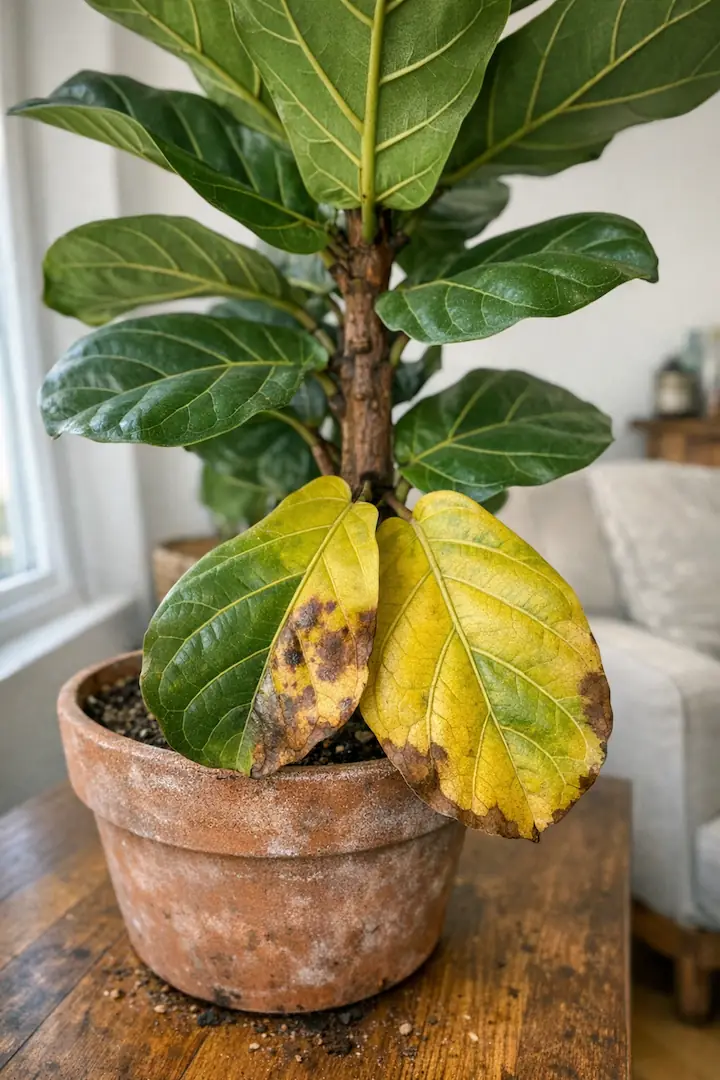
Fiddle leaf figs have a reputation for being difficult. That reputation is half earned.
They are sensitive. They are also consistent. Yellow leaves on a fiddle leaf fig always follow a pattern, and that pattern tells you exactly what's wrong if you know how to read it. The plant isn't being difficult. It's being specific.
| What you're seeing | Most likely reason |
|---|---|
| Lower leaves yellowing one at a time | Natural aging, normal cycle |
| Multiple leaves yellowing at once, soil wet | Overwatering, check roots immediately |
| Yellow leaves with brown spots in the center | Root rot, unpot and inspect today |
| Yellowing starting at edges and tips | Underwatering or low humidity |
| New leaves at top coming in pale yellow | Nutrient deficiency or root stress |
| Yellowing after moving to a new spot | Relocation stress, give it six weeks |
Where the Yellowing Starts Matters
This is the diagnostic detail most people miss.
Yellowing that starts at the bottom of the plant and moves upward slowly, one leaf at a time over weeks, is the plant's natural aging cycle. Fiddle leaf figs shed their oldest leaves continuously as they push new growth from the top. One yellow leaf every few weeks with an otherwise healthy plant is not a problem.
Yellowing that starts in the middle of the plant or affects multiple leaves at once is always a signal of something wrong. The location within the leaf matters too. Yellow spreading from the center outward points to root problems. Yellow spreading from the edges inward points to environmental stress like low humidity or inconsistent watering.
Overwatering
Multiple leaves yellowing at once with wet soil underneath is overwatering until proven otherwise.
Fiddle leaf figs are particularly sensitive to waterlogged soil because their roots need significant oxygen to function. Saturated soil cuts off that oxygen and the roots begin to fail within days. The plant responds by abandoning its oldest and largest leaves first, which require the most resources to maintain.
The yellowing from overwatering tends to be uneven and patchy within each leaf rather than uniform. The leaf may develop soft spots or brown patches within the yellow area as the tissue breaks down.
Let the soil dry to three centimeters deep before watering again. In a standard indoor environment that means every ten to fourteen days in summer and every eighteen to twenty five days in winter. A moisture meter at the bottom of the pot is the only reliable way to know when a fiddle leaf fig actually needs water, because the surface of a large pot can be completely dry while the roots are still sitting in moisture.
Root Rot
Yellow leaves combined with brown spots that have a darker border, soft stems near the base, or soil that smells like decay means the overwatering has progressed to root rot.
Pull the plant out of its pot. Healthy roots are white and firm. Roots affected by rot are brown, dark, and soft. Cut away everything that isn't firm and white, treat the cuts with powdered cinnamon as an antifungal, let the roots air dry for an hour, and repot in fresh well-draining soil.
Remove any leaf that is more than halfway yellow before repotting. A plant recovering from root rot cannot support leaves it was already abandoning.
Relocation Stress
Fiddle leaf figs yellow leaves when moved. This is not negotiable and it is not a sign that something is wrong with the care.
The plant grows its leaves calibrated to a specific light angle, intensity, and temperature. When those change, even slightly, it sheds the leaves that no longer make sense for the new conditions and grows new ones suited to where it is now. This process takes four to eight weeks and involves losing real leaves.
The only fix is to stop moving the plant. Every relocation restarts the clock. Pick the best spot available near a bright window with indirect light, place the plant there, and do not move it again regardless of how it looks for the first month.
Nutrient Deficiency
New leaves emerging pale yellow rather than the deep green fiddle leaf figs are known for points to a nutrient problem.
Nitrogen deficiency produces uniform pale yellowing on new growth. Iron deficiency produces yellowing between the veins while the veins themselves stay green. Both can result from depleted soil or from a soil pH that has drifted too high to allow nutrient absorption.
A balanced liquid fertilizer applied once a month from spring through summer addresses nitrogen deficiency directly. If the yellowing pattern is between the veins specifically, a liquid iron supplement applied once usually resolves it within two to three weeks of new growth.
Do not fertilize a plant that is already stressed from overwatering or root rot. Fertilizer salts accumulate in damaged roots and cause additional harm. Wait until the plant shows signs of recovery before feeding.
What To Do Right Now
- Look at which leaves are yellowing and where on those leaves the color change starts. That pattern is the diagnosis
- Press the soil before assuming anything. Wet soil with yellow leaves means stop watering. Dry soil with yellow leaves means water thoroughly
- Pull the plant out if the stems feel soft near the base or the soil smells like decay. Check the roots directly
- If you moved the plant recently, move it back to its original spot or commit to the new location and leave it completely alone for six weeks
- Check when you last fertilized. If it's been more than six months and the new leaves are coming in pale, that is likely the missing piece
Keep reading
// Newsletter
New plant problem? We'll email you the fix.
No spam. One email when we publish something useful.
No spam. Unsubscribe any time.