 PlantProblem
Peace Lily Brown Tips: Causes, Fixes, and What to Do Right Now
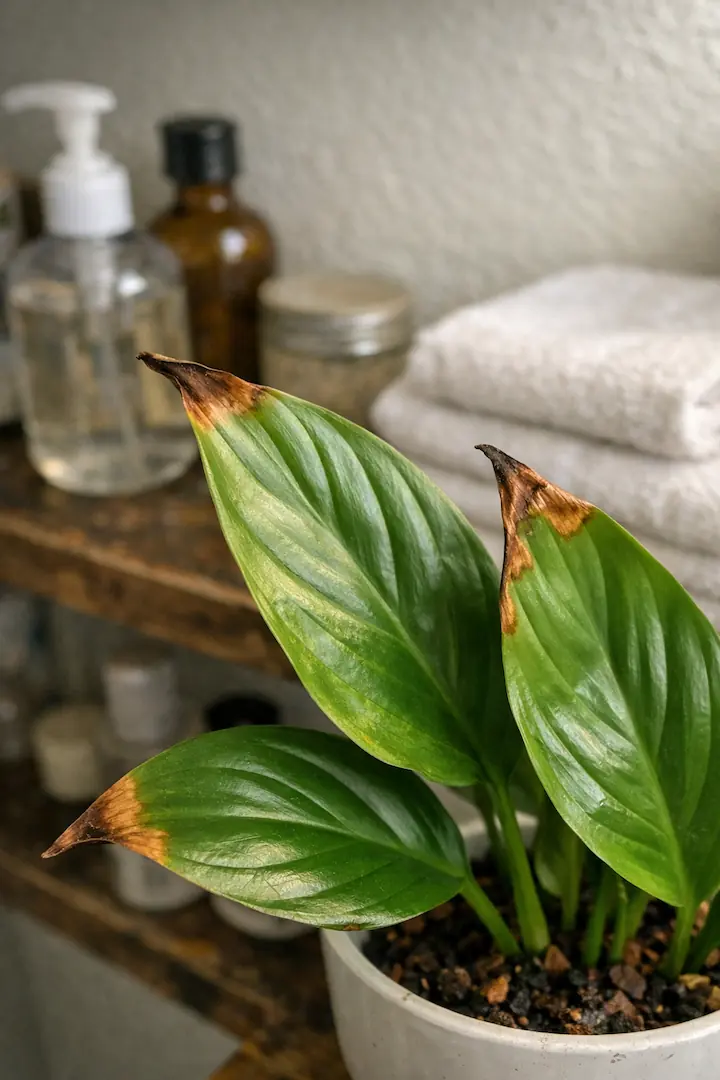
Peace lily brown tips are not an emergency. They are information.
The browning doesn't reverse once it's there, but it stops completely once you fix the cause. New leaves come in clean. The plant doesn't care about the old ones once you've solved it.
| What you're seeing | Most likely reason |
|---|---|
| Tips brown and crispy, edges dry | Low humidity or fluoride in tap water |
| Brown tips plus yellowing lower leaves | Overwatering, check soil moisture |
| Tips brown after moving near a heater or vent | Dry hot air, relocate the plant |
| Brown spreading down the entire leaf edge | Fluoride toxicity from tap water buildup |
| New leaves browning at the tip before fully opening | Very low humidity or root stress |
| Tips brown on all leaves at once after repotting | Transplant stress, resolves on its own |
Tap Water and Fluoride
This is the cause nobody considers first and the one responsible for most persistent tip browning in peace lilies.
Peace lilies are among the most fluoride-sensitive houseplants available. Municipal tap water contains fluoride at levels that accumulate in the soil with every watering. Once concentrations reach a threshold the plant can't tolerate, the damage shows at the leaf tips first and works inward.
The pattern is distinctive: browning that starts at the very tip and moves down the edge of the leaf in a narrow strip. It progresses slowly over weeks rather than appearing suddenly.
The fix is straightforward. Switch to filtered water, distilled water, or rainwater. Let tap water sit uncovered for 24 hours before using it — this removes chlorine but not fluoride, so it helps partially but not completely. Once a month, flush the soil thoroughly with distilled water to clear accumulated salts. New growth after the switch comes in without browning within four to six weeks.
Low Humidity
Peace lilies are tropical plants that want humidity above 40%.
Most heated or air-conditioned homes run between 25% and 35% in winter. Below 40%, the leaf tips desiccate faster than the roots can replenish moisture to the outermost cells. The tips are the furthest point from the root system and the first to show the deficit.
This browning is dry and papery. The rest of the leaf looks healthy. It doesn't spread quickly. It gets worse in winter when heating runs constantly and improves in summer when outdoor humidity is higher.
A humidifier placed within two meters of the plant is the reliable fix. Running it at 50% to 60% is enough. Misting does not work — it evaporates in minutes and doesn't raise ambient humidity meaningfully. Grouping plants together raises local humidity slightly through transpiration but not enough to resolve the problem in a dry room.
Overwatering
Brown tips combined with yellowing on the lower leaves and damp soil points to a root problem rather than humidity.
Roots that are stressed from overwatering can't transport water efficiently to the extremities of the leaf. The tips are the last point in the delivery chain and the first to show when that chain is compromised. The browning from overwatering tends to be slightly softer than the crispy browning from dry air.
Check the soil before the next watering. The top half should be dry, not just the surface. If you're watering more than once a week in a standard-sized pot, that's too frequent for most indoor conditions. A moisture meter removes the guesswork — peace lilies want a reading of 3 to 4 at the midpoint of the pot before the next watering.
Heat and Direct Airflow
A peace lily sitting near a heating vent, radiator, or air conditioning unit receives bursts of dry air directly on the leaves regardless of the room's overall humidity.
The tips brown from the direct airflow even when the plant is otherwise well-cared-for. The browning is concentrated on whichever leaves face the air source. Moving the plant one meter away from any vent or radiator stops new browning within two weeks as the plant adjusts.
Direct sun also causes tip browning through a different mechanism — leaf scorch rather than desiccation — but the result looks similar. Peace lilies want bright indirect light, not direct rays. A sheer curtain between the plant and a south-facing window is usually enough.
What To Do Right Now
- Switch to filtered or distilled water for the next three waterings and see if new growth comes in without browning. This single change resolves the majority of cases
- Check what's within one meter of the plant. Heating vents, radiators, and air conditioning units cause more tip damage than most people realize
- Trim the existing brown tips with clean scissors cut at a slight angle to match the natural leaf shape. It doesn't help the plant but it stops the browning from looking worse than it is and makes it easier to track whether new browning is appearing
- Check the soil before the next watering. If it's still damp, wait regardless of when you last watered
Keep reading
// Newsletter
New plant problem? We'll email you the fix.
No spam. One email when we publish something useful.
No spam. Unsubscribe any time.